Everyone’s talking about AI as a productivity engine. Very few are asking what happens when you plug it into broken systems. This article is about that gap and why most companies aren’t ready.
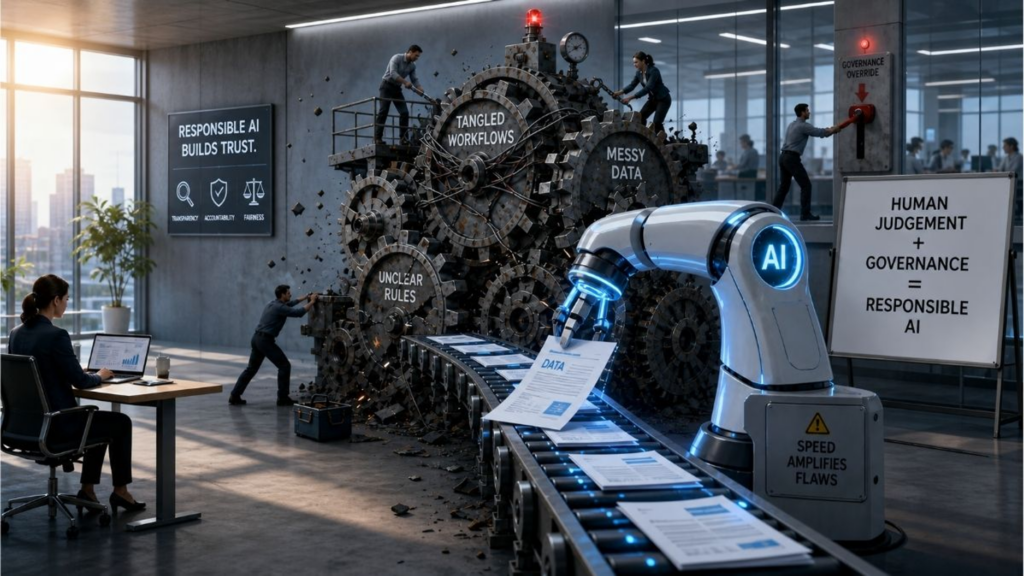
Weak systems, faster failure
A growing number of organizations are regretting their early wave of AI-driven layoffs. Roles that were cut on the assumption that automation could fully replace them are, in many cases, being reintroduced. Sometimes under different titles, sometimes with the same people returning.
What looked efficient in a controlled demo is proving messier in live environments, where systems struggle with context, edge cases, and judgment. Companies are discovering that removing human oversight doesn’t eliminate complexity – it exposes it.
The work hasn’t disappeared. It has fragmented, stalled, or degraded in quality, forcing leaders to step back and rebuild capability with people back in the loop.
Companies announcing layoffs due to AI are acting on expected returns, even as the actual ROI remains inconsistent and difficult to prove. AI ROI is mostly guesswork. Time saved isn’t the same as value, but it’s treated as if it were. Decisions are being made as if it’s already real.
The reliability problem
We’ve already seen what that looks like in practice.
A Toronto lawyer relied on AI-generated research and ended up citing legal cases that didn’t exist, forcing the court to respond. A Toronto customer negotiated a $27,000 BMW buyback with what he thought was a dealership rep. Quinn was an AI chatbot that had misread his loan balance as the car’s market value. The dealership tried to walk it back, then reversed course after a news outlet picked up the story.
The Deloitte case reinforces the same point. A $1.6 million healthcare report commissioned by a Canadian provincial government contains fabricated citations likely generated by AI. It has triggered calls for regulation and remains under review.
At scale, a Meta AI-assisted account-recovery tool enabled attackers to take over more than 20,000 Instagram accounts. Not because of sophisticated hacking, but because the system failed at a basic function: verifying the email address before issuing a password reset.
At the same time, ROI remains inconsistent, with most organizations failing to see measurable returns in the first year. The gap isn’t just technical; it’s operational. AI is being deployed into complex environments faster than organizations can build the governance, validation, and oversight required to use it safely.
The real risk
Governance, security, and data are where most companies will get burned.
Right now, your biggest AI risk isn’t jobs disappearing. It’s people using unsanctioned tools and leaking company data everywhere. Most leaders don’t know what’s leaving the building, where it ends up, or whether it’s training someone else’s model.
This is where the job apocalypse story falls apart. Most companies are not going to build their own models or hire research teams. They’ll switch on AI features in tools they already pay for, plug in a few specialized products where they have bottlenecks, and maybe rent intelligence as a metered utility if Sam Altman has his way. A playbook to get users dependent first, then squeeze them later.
Whether utopia or trap, the metered future is far from certain.
Either way, the hard work isn’t training a model. It’s deciding where these systems are allowed to touch the work, what data they can see, which decisions are off-limits, and who is accountable when the machine gets it wrong.
The weak link problem
In economics, there’s a rule. When a system depends on many interconnected tasks, the overall outcome isn’t determined by your best performer. It’s capped by your worst one.
It’s the weakest-link problem in plain language. The chain breaks where it’s thinnest, no matter how strong the rest is.
You can have the world’s greatest marketing, but if your product is faulty, you fail. You can have a brilliant strategy, but if your data is garbage, your decisions will be garbage too.
In most workplaces, those weak links aren’t about speed or volume. They’re unclear goals, messy workflows, bad data, or inconsistent rules about how decisions get made.
AI is great at turbocharging the strong parts. But if the weak links stay broken, you don’t improve the system. You push more work through a flawed process, faster.
The real barriers to quality, fairness, and good judgment don’t disappear. They get harder to see because everything appears busier.
The narrative vs reality
You’ve probably seen the headline: “99% of CEOs expect to cut jobs because of AI.” It sounds dramatic, but it needs context.
That number comes from Mercer’s 2026 Global Talent Trends report, a consulting firm that profits from helping companies redesign work and implement AI. The full survey engaged nearly 12,000 respondents, but the 99% figure comes from just 825 C-suite executives.
Even then, the bar was extremely low. It counted any expectation of “some” job loss, whether that means cutting two roles or two thousand.
So while the headline grabs attention, it doesn’t tell you how severe or widespread the cuts will be. It tells you that most CEOs think some reduction is possible, which is far from the mass replacement story it implies.
Where AI is actually working
Where AI works best depends on the type of system.
Generative AI performs well on bounded, criteria-driven tasks such as drafting, summarizing, searching, and extracting, where outputs can be reviewed, and errors are low risk.
Agentic AI, systems that can take multi-step actions on their own, goes a step further. But only in tightly controlled environments where steps are predefined, outcomes are measurable, and exceptions are limited.
In both cases, performance depends less on the model’s sophistication and more on the environment’s structure. The more predictable the workflow, the clearer the rules, and the cleaner the data, the more reliable the system becomes.
Outside of those conditions, where ambiguity, judgment, or accountability are central, these systems don’t replace work. They introduce risk.
In every case, AI works because the environment is controlled, not because the technology is universally capable. The work is engineered to fit the technology, not the other way around.
This isn’t general intelligence replacing work. It’s targeted automation applied to narrow problems under tightly controlled conditions.
And even there, humans are still embedded, handling edge cases, correcting errors, and absorbing risk when things break. That gap isn’t small; it’s structural.
Automation can scale processes, but it also scales errors when guardrails are weak.
Replacing human roles with AI isn’t just about cost or efficiency. It’s about whether the system is stable enough to withstand the consequences of failure. When systems can’t consistently handle nuance, edge cases, or accountability, removing humans doesn’t eliminate work. It concentrates risk, usually in places that are harder and far more expensive to fix later.
The work we pretend is simple.
When people ask me how many jobs AI will replace, here’s what I tell them: we have no idea. Anyone who claims certainty, especially in neat percentages, is telling you more about their misunderstanding of work than anything else.
Jobs don’t break down that cleanly.
If work were just what’s written in the job description, this would all be easy. But it’s not. There’s the JD, and then there’s the real job. The workarounds everyone agrees to. The political capital it takes to move anything forward. The side conversations, the context, the trade-offs.
If you don’t understand how work really flows through your business from A to Z, who touches it, when, how often, where it breaks, and how it connects to how you make money, you are not ready for AI.
If you did understand it, you’d be optimizing what already exists. You’d probably discover that your current systems can do far more than you’re asking of them.
Work design has always happened at the manager level. The people closest to the work are the only ones who can realistically map it and improve it. If they’re not at the table, you’re automating a fictional version of your organization.
Change doesn’t happen all at once
This isn’t a cliff.
We’re not going to start on Monday and watch entire professions vanish by Friday. That’s not how any major technology shift has ever worked.
The internet didn’t wipe out industries overnight. Newspapers declined over decades. Mobile didn’t reset everything in a week. It reshaped behaviour slowly.
What happens is slower and harder to see.
AI goes after tasks. It chips away at workflows. It removes manual effort and increases speed. Over time, expectations shift, throughput increases, and roles begin to evolve around a new baseline.
In some cases, fewer people are needed, but gradually, unevenly, and often without a single obvious tipping point.
That’s why this moment feels so confusing. It’s too early for a clean answer. Too late to ignore.
Talent and judgment
AI does not lower the bar for talent. If anything, it raises it.
Once you plug automation into a process, humans start to over-trust it, leading to automation bias. If nobody in the room has deep domain expertise, the organization will default to whatever the system produces.
If you hollow out expertise because the tool fills the gaps, you magnify your risk.
If you hire and develop strong people, and teach them to use AI critically, when to trust it, when to question it, when to override it, the technology becomes genuinely useful.
The gap we can’t measure
Think about what it takes to do what a human does. Not the headline stuff, the mundane stuff. The things you don’t think about.
You walk into a room. You recognize a face you haven’t seen in years. You pick up on a shift in tone. Someone’s annoyed, but they’re trying not to show it. You reach for a cup without looking. You know exactly how much pressure to apply so you don’t crush it.
None of this is remarkable. It takes no effort.
But every one of those actions requires a cascade of processing, vision, memory, social inference, motor control, and prediction. No machine comes close to replicating it.
The brain runs all of it in parallel, on about 20 watts of power, without a manual, without a reboot, for decades.
We still don’t fully understand how any of it works end-to-end. We don’t know, in full, how memory is stored, how consciousness arises, or what happens when you have a thought.
And yet we’re supposed to believe we’re close to building a machine that thinks like a person?
We’re not close. We’re not even in the same galaxy.
The gap between what we’ve built and what a human is is so wide it’s almost invisible because we keep looking at the wrong things.
We measure tokens, parameters, and benchmark scores. But we’re not measuring what matters. We’re not measuring judgment. We’re not measuring wisdom. We’re not measuring the unremarkable intelligence it takes to be a decent human being in a complicated world.
Final take
Adoption takes time. The internet didn’t kill newspapers in a year. It took twenty. The same pattern will hold here, and probably longer.
So no, I don’t buy the Hollywood version of a job apocalypse. The shift will be slow, uneven, and very real.
The danger isn’t that it happens overnight. The danger is that leaders underestimate it because it doesn’t.
Infrastructure is nowhere near ready. Most companies can’t even get their basic data in order, let alone build the governance and oversight required to run these systems safely at scale.
Meanwhile, there are growing signs that LLMs are nearing a wall. Diminishing returns with each new generation, exploding costs, and fundamental, unsolved problems in reasoning and reliability.
The technology is impressive, but it’s not magic. It’s not infinite.
The apocalypse isn’t coming next Tuesday. But the slow grind of erosion, task by task, workflow by workflow, is already here.
When leaders mistake speed for progress and headlines for reality, they make decisions that are hard to undo.
The real question isn’t whether jobs change. It’s whether we change with them or let the hype cycle make our choices for us.