Across organizations, AI entered HR through product updates, reshaping who gets hired, promoted, or managed out before most leadership teams had reason to examine it closely. This article looks at how unvalidated AI features embedded in common HR tools create governance and compliance exposure, why CHROs are being held accountable for systems they did not select, and what oversight should look like in 2026 for Canadian employers.
The problem, stated clearly
AI is already in the HR stack. That is the problem.
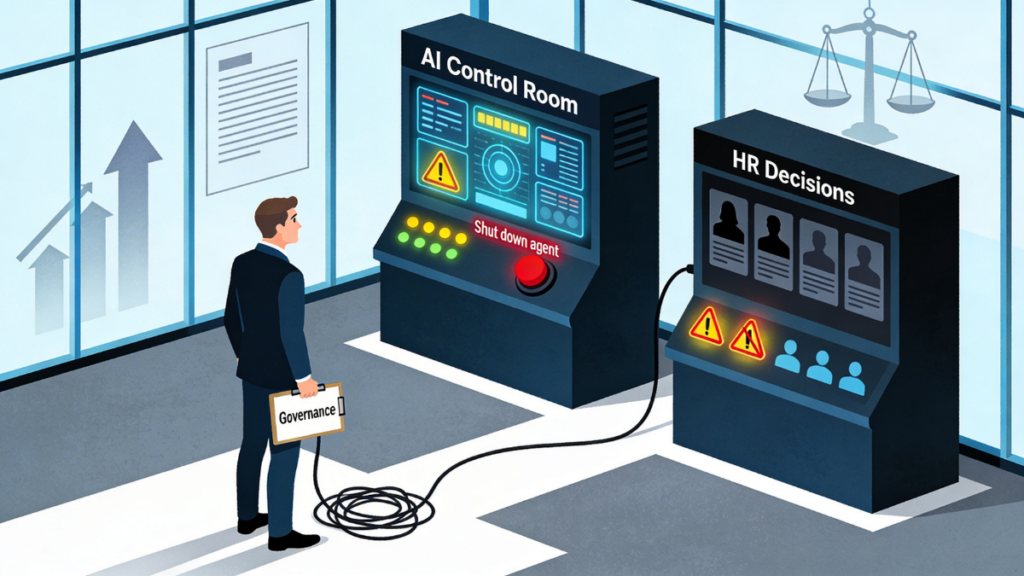
Firms such as KPMG are publishing guidance on emergency stop mechanisms and control frameworks for AI agents. Set against that, there is a narrower question for HR systems that influence employment decisions, often without comparable scrutiny.
How AI actually entered HR
In most organizations, AI did not arrive through a single decision.
It appeared inside tools that were already in use.
The ATS introduced AI screening. The HCM introduced talent matching. Point solutions layered in interview scoring or performance nudges.
There was no moment when the organization paused to consider whether it was comfortable with an opaque system influencing hiring, promotion, or exit decisions. The capability was released, enabled, and absorbed into existing workflows.
The validation gap
The gap becomes clearer with newer tools that sit atop LinkedIn, ATS, or internal communication platforms.
These tools often lack independent validation, do not publish bias audits, and provide limited documentation that can be reproduced or interrogated internally.
The underlying elements remain unclear. The training data is not visible. The handling of that data is not transparent. Performance measures are described at a high level but not demonstrated in a way that allows replication. Behaviour outside the training population is rarely tested in ways accessible to the organization using the tool.
What is available is positioning language: debiased, validated, trusted, ethical by design.
What is typically absent is documentation that can be presented to a regulator or defended with confidence under examination.
Governance and operational reality
Governance practices are evolving in parallel.
Risk, IT, and advisory firms are building structured frameworks around AI. These include monitoring, escalation paths, and mechanisms to interrupt systems when they behave unexpectedly. Where AI has authority to move funds, deploy code, or affect infrastructure, these controls are necessary.
The contrast is operational.
Controls of this kind are appearing in systems with visible and immediate impact. They are less common in systems that influence employment decisions, where the effects accumulate more gradually and are harder to isolate.
The limits of “human in the loop”
The default control in HR systems is still human oversight.
The expectation is that a person will review the outputs and correct anything that does not appear reasonable.
Observed behaviour does not consistently support that assumption.
When algorithmic recommendations are presented, decision-makers tend to align with them. This holds even when the recommendation introduces bias. When the recommendation is removed, decision patterns become more varied and less dependent on a single signal.
Once a system produces an answer, it begins to shape the range of acceptable decisions.
A human checkpoint remains, but its independence narrows.
Ownership without control
Responsibility is also unevenly distributed.
Workplace AI surveys, including Beamery’s 2025 research, describe HR as peripheral to many AI decisions, with responsibility concentrated among CEOs, CIOs, and digital functions. At the same time, accountability for employment outcomes remains with HR leadership.
That creates a structural imbalance.
The function expected to explain outcomes does not control the systems producing them.
The current state inside organizations
The patterns are consistent.
The pattern inside most organizations is consistent, even if it is not always visible. The tools are not fully transparent, and validation tends to be limited or inaccessible in ways that matter under scrutiny. At the same time, decision-makers begin to rely on system outputs as part of normal workflow, often without revisiting how those outputs are produced. External expectations continue to shift, with increasing emphasis on auditability and the ability to explain decisions in concrete terms. Accountability, however, has not shifted with those expectations. It continues to rest with HR, even where the systems shaping outcomes are not fully understood or controlled.
The misalignment is not immediately visible, but it becomes relevant when a decision is challenged, and the organization needs to explain how it was made.
The questions that begin to surface
At that point, a different set of questions emerges.
Which tools in the HR stack contain embedded AI, and where do they influence hiring, promotion, performance, or exits?
What documentation exists that describes how the model was trained, what data it uses, and how performance and bias were evaluated?
Is there an independent audit that can be shared externally and reproduced internally?
Who has the authority to suspend or reject a system if those questions cannot be answered?
Where accountability settles
The answers are not always located in the same place as accountability.
If any function is asked to define fairness, transparency, and acceptable use in employment decisions, it will be HR. That includes deciding where human judgment must remain primary, and when a system cannot be used until its behaviour is sufficiently understood.
That responsibility does not expand the function’s control over the tools, but it does define its exposure.
The bottom line
When these questions cannot be answered, AI does not function as an advantage.
It operates as an embedded risk in employment decisions, with ownership of the outcome separated from control over the system.
The issue does not originate in the technology.
It emerges in governance.