Ageism used to be a late-career problem. The evidence suggests it begins much earlier, and AI sourcing may make it permanent.
The visibility problem
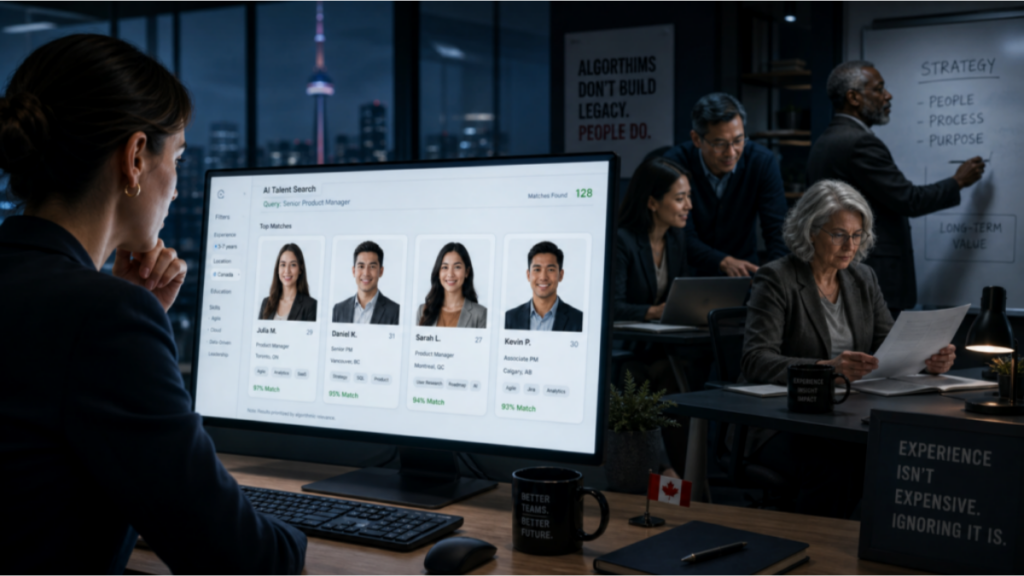
Most organizations believe they are searching the labour market when they hire. In practice, they are searching whatever portion of the workforce is visible inside their tools, and those two things are not the same.
Talent visibility has quietly become a proxy for talent availability. When workers do not surface in sourcing platforms or do not generate visible activity signals, they fall out of hiring pipelines regardless of their actual capability, performance, or track record.
A massive market, partially seen
Now consider the size of the market this logic applies to.
Approximately 3.7 billion people are participating in the global labour market today, representing about 61 percent of the population aged 15 and over. They are employed, self-employed, or actively seeking work, creating an enormous pool of human capability.
The issue is not whether the talent exists. The issue is how much of it is actually visible to the systems organizations rely on to find people. When visibility becomes the filter, the labour market effectively shrinks to whatever those systems can detect.
Where ageism actually starts
Most people still think of ageism as something that affects workers in their late 50s, a problem for later and not particularly relevant to those in mid-career. That assumption breaks down when you look at how hiring decisions are actually being made.
The 42-year-old operations manager sitting in Tuesday’s hiring meeting likely believes they are evaluating a representative slate of candidates. What they do not see is that the tools generating that slate may already be excluding people with profiles very similar to their own.
40 as the inflection point
Research is increasingly pointing to 40 as the real inflection point. Across labour market participation data, callback studies, and platform behaviour research, the pattern is consistent.
This shift is not driven by a drop in capability. It is driven by a drop in visibility. As careers stabilize, outward signals change. Role changes become less frequent, public updates decline, and digital footprints become quieter, all of which reduces how often these workers appear in search results.
The workforce we are not seeing
From a macro perspective, the workforce is already older than most hiring assumptions reflect, particularly in Canada.
A majority of working Canadians are over 35, and roughly one in five workers is 55 or older. These individuals are active, employed, and contributing across sectors. What has changed is not their participation, but how they show up in systems designed to detect activity rather than sustained contribution.
Many have not stopped working. They have stopped producing the kind of algorithm-readable signals that modern sourcing tools prioritize.
Visibility versus reality
When people are deep in their work, managing complexity, maintaining relationships, and preventing problems before they escalate, visibility is rarely the focus. Their value shows up in stability, continuity, and outcomes that often look like nothing happened at all.
Recruiting processes, however, tend to centre on what is easiest to see and compare. This creates a structural bias toward highly visible, highly active candidates, even when those signals are only loosely connected to long-term performance.
Platform bias in plain sight
This gap becomes clearer when you look at platform dynamics.
LinkedIn visibility, when compared with the Canadian labour force composition, skews heavily toward early-career workers. While adults aged 35 to 54 represent the largest segment of the workforce, their platform presence is noticeably lower and continues to decline as careers mature. Workers over 55 are barely represented at all.
This is not about disengagement or declining skill. It reflects how the platform is used, primarily by those in earlier stages of their careers who are actively signalling, networking, and transitioning.
Labour force participation tells us who is working. Platform visibility indicates who appears in search results. When hiring practices treat those as interchangeable, the gap between them becomes a source of systematic exclusion.
Where 40 enters the system
This is where 40 enters the equation in a meaningful way.
Modern ageism is less about age itself and more about how systems interpret patterns like stability, tenure, and reduced visible activity. In environments that equate speed and visibility with competence, these signals are often misread as stagnation, even when they reflect depth and consistency.
What mid-career actually looks like
Research on mid-career development tells a very different story from the one implied by these systems.
Rather than decline, this stage is typically marked by what psychologist Erik Erikson described as generativity. That includes investing in others, strengthening teams, preserving institutional knowledge, exercising judgement, and focusing on longer-term outcomes.
This form of contribution is structurally valuable, but it does not translate easily into the signals captured by sourcing and performance systems. As a result, it is frequently underrepresented or missed altogether.
Why experience becomes scarcer and more valuable
As AI continues to absorb transactional and pattern-based work, the value of human contribution shifts toward areas that are harder to replicate.
Context, judgement, and trust become the differentiators, precisely the domains where experienced workers tend to contribute most. At the same time, these contributions are less visible, less standardized, and more difficult to quantify, which makes them easier to overlook in automated systems.
The economic case
The economic implications extend beyond hiring practices.
Population aging is expected to put downward pressure on GDP per capita across advanced economies if employment patterns remain unchanged. Improving labour market outcomes for people over 50 has been shown to meaningfully increase growth projections, and Canada sits directly within these dynamics.
At the firm level, age-diverse teams consistently produce stronger innovation outcomes, while the loss of experienced workers without effective knowledge transfer reduces quality, efficiency, and adaptability.
This is not simply a fairness issue. It is an issue of economic performance.
When AI scales the blind spot
The introduction of AI sourcing compounds the problem.
These systems learn from existing data, and that data is already skewed toward workers who are more visible on digital platforms. Even without explicitly including age, models rely on proxies such as tenure, career progression patterns, and activity levels.
Because these signals tend to shift in the early forties, the model learns to rank accordingly. The outcome is not intentional discrimination, but it produces the same effect at scale.
The illusion of talent shortage
This leads to a familiar conclusion.
Organizations using AI sourcing end up competing for the same narrow, highly visible segment of the workforce. Meanwhile, experienced workers who bring judgement, context, and institutional knowledge are never surfaced, ranked, or contacted.
The resulting talent shortage appears real, as the data support it. In reality, it reflects a partial view of the labour market shaped by what the system can see.
Who this really affects
The mid-career professionals making hiring decisions today often do not see themselves as being at risk of age-based exclusion.
However, the same systems they trust are already narrowing the field around people like them. Not because capability has diminished, but because their behaviour no longer aligns with what the algorithm rewards.
The core question
The workers are there, and the capability is there.
The more important question is whether the tools we rely on to find that talent are actually capable of recognizing it.
Related Insights
Is Canada’s AI Upskilling Frenzy Real or Just Consulting Firms Chasing Revenue?
What the Eightfold Lawsuit Is Telling Us About the Future of AI in Hiring
Canadian Employers Face Legal Exposure as AI Outpaces Policy