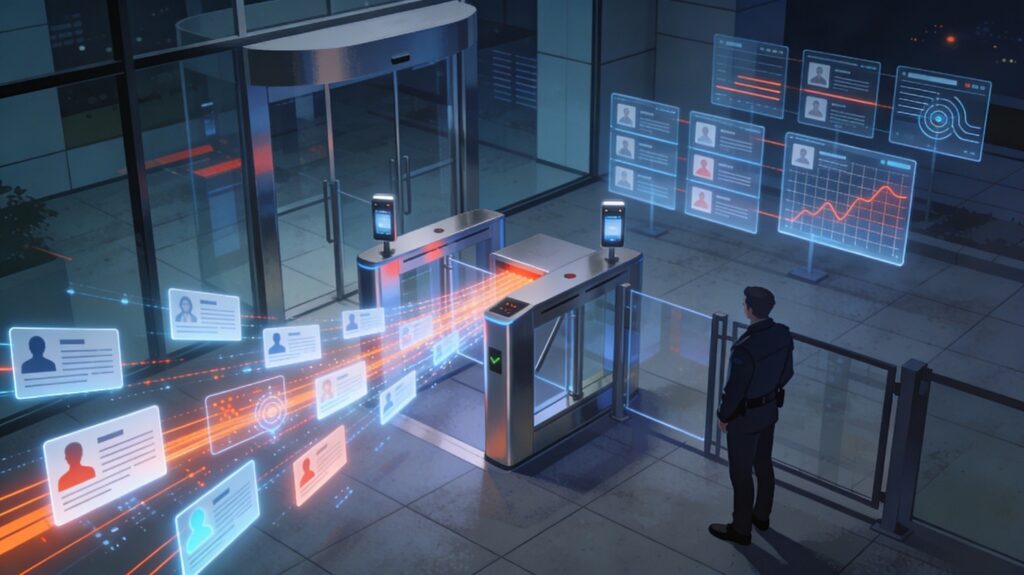
We still call it talent acquisition, but that’s not what your stack is doing anymore. Your hiring system is an access-control layer that strangers touch all day. When trust breaks, the question isn’t just “who did we hire?” It’s “who did we let in?” Candidates are using AI to compress and polish themselves at scale. Recruiters, buried in volume and judged on speed, are using AI to compress and process candidates at scale. Platforms keep rolling out new AI features, sometimes on purpose, sometimes because an update ships while everyone’s in meetings. Somewhere in the middle, your ATS quietly stopped behaving like a neutral HR database and started functioning like access control.
Last week, I wrote about the shadow AI stack running through organizations whether leaders approved it or not. This is the sequel, but this time the flashlight is pointed at hiring.
Canada keeps telling itself a calming story about AI. We aren’t seeing the same big, AI-branded white-collar layoffs that dominate headlines elsewhere. Early Canadian data may not show jobs falling off a cliff in roles more exposed to generative AI. That calm might be real in the numbers. It isn’t real in how people feel.
On paper, AI adoption still looks small. Statistics Canada’s latest analysis puts AI use among Canadian businesses at 12.2 percent – companies using it to produce or deliver, not just bang out an email. That number doubled in a year. Leaders tend to find that comforting. Double of small is still small, and the rollout plans make it look like most organizations are still watching. But that survey measures what companies report. It doesn’t measure what people do when they’re under pressure and nobody’s looking.
The real force shaping behaviour isn’t your policy manual or your town hall. It’s what people see when they’re scrolling in the dark.
They see headlines about AI reshaping work and asking ugly questions about the future. They watch videos of educated workers who’ve been out of work for months, talking honestly about how they’re getting by – and how it’s messing with their mental health – in ways no town hall ever really addresses. In the same feed, they see executives praising AI for “more efficiency” and “leaner teams,” followed by layoff announcements. They see the stock go up. They see careers turned into a talking point on an earnings call. That’s the backdrop.
Whatever story you’re telling inside the company is competing with that. If you don’t talk about it, you don’t make it go away. You just leave people to figure it out on their own.
So when leaders say, we’re going slow, we’re cautious, we’re building governance, they may mean it. What a lot of employees hear is something else: you’re on your own. This is where the psychological contract stops sounding like HR jargon and starts acting like plumbing – the kind nobody notices until something bursts. Underneath all the engagement work and employer branding is one unwritten deal: if you show up and try, the organization won’t treat you as disposable.
When people stop believing that, they don’t forget how to work. They quietly reprice the relationship. Some leave. Many stay and do what the contract on paper demands, nothing more. More importantly, they stop volunteering information. They stop experimenting in the open. They stop assuming anyone’s steering. They don’t stop using the tools. They just stop letting you see them. That isn’t rebellion. It’s self‑protection.
That’s the real risk with shadow AI. It doesn’t start as defiance. It starts as trying to get the work done. A recruiter grabs an unapproved sourcing tool. A solo HR lead glues workflows together with whatever’s at hand. A team hangs AI off systems that were never built for it just to keep up with demand. Each move makes sense on its own. Put together, they turn into an unmonitored network of data flows, dependencies, and weak spots nobody has signed off on.
Now pour that straight into hiring.
Hiring used to be selection. Now it’s admission. Admission is access control.
Your applicant tracking system isn’t a neutral HR database. It’s an access point with a logo and a candidate experience page bolted on. It holds identity data, work histories, contact details, addresses, assessments, internal notes, and decision trails. It’s basically a passport office with better design, and it’s built to be touched by the outside world all day. Candidates touch it. Agencies touch it. Vendors touch it. Screening tools, scheduling tools, chatbots, and every new AI helper touch it. Every integration is another hand on the door handle. Every hand on the handle is a risk you picked up whether you meant to or not.
This is usually where someone says, we haven’t turned AI on in hiring. In a lot of organizations, that line is technically true and practically useless. Candidates are using AI to compress and polish themselves at scale. Recruiters, buried in volume and judged on speed, are using AI to compress and process candidates at scale. Platforms keep rolling out AI features, sometimes on purpose, sometimes because an update shipped while everyone was in meetings. Hiring turns into a contest between candidate automation and employer automation. You get a smoother process and a worse read on people. Speed and polish aren’t the same thing as judgment.
More and more, the question is what’s real at all. Real people are there. Fake people are starting to show up too: AI-generated profiles, synthetic resumes, scripted interview answers spun up in minutes. Real people with AI leverage are there as well, able to generate the perfect version of themselves for each posting and do it again tomorrow. At some point, hiring stops feeling like talent selection and starts feeling like working the door at a club where every ID looks professionally printed and your KPI is keeping the line moving. Bad intent goes where it can hide. You don’t pick pockets in an empty field. You go where the crowd gives you cover. High‑throughput hiring funnels are built for volume. That same volume creates exactly the kind of crowd attackers like – busy and distracted. They don’t need to look exceptional. They just need to look normal.
When trust breaks, the question isn’t just “who did we hire?” It’s “who did we let in?”
If that still feels abstract, look at what a basic failure looks like at scale. In 2025, security researchers Ian Carroll and Sam Curry found that McDonald’s AI-powered hiring platform, McHire, was running with a default admin username and a password of 123456, no multifactor authentication, and an internal API that let them click through applicant data record by record. That setup exposed sensitive information for tens of millions of job seekers – names, contact details, application histories, chat transcripts – before it was fixed. This wasn’t a genius hack. It was the key under the mat and the front door half open.
If you understand how these systems plug into each other and you’re looking for a way into an organization, you don’t start at the firewall. You start where strangers are already invited in: hiring. Around the ATS, a thicket of productivity tools grows: sourcing extensions, scheduling assistants, auto-screening plugins, chatbots. You don’t flip one big AI switch. You quietly add dozens of small ones.
This is the part a lot of leaders just walk past. If AI delivers the ROI they’re chasing, they’ll build an army of agents and call it progress while their workforce watches the value of human judgment get marked down in real time. If AI doesn’t deliver that ROI, or never scales past a few bright spots, they still inherit the damage from the chase: a fractured workforce, lower trust, quieter employees, and a psychological contract that doesn’t knit itself back together on command. Either way, there’s a bill at the end. The only question is whether the bill shows up first on the balance sheet or in the behaviour of the people still inside the building.
This is where the psychological contract plugs back into the tech stack. When trust is even halfway intact, people surface risk early. They ask before pasting data into tools. They flag weird behaviour. They run experiments in the open, where the organization can see what’s going on and put guardrails around it. When trust is thin, the work doesn’t stop. It just goes underground. People work around the process instead of through it. They tick the boxes on the surface and protect themselves underneath. The more you moralize tool use, the further it moves out of sight. Shame is very good at pushing risk out of view.
This is also where “human in the loop” starts to sound less like a control and more like a bedtime story. If systems decide who sees the job, who gets screened, and how candidates are ranked, and the human job is to skim the output under a time‑to‑fill target, the real judgment already happened upstream. The human is just the signature at the bottom. You can outsource judgment. You can’t outsource accountability.
By the time people are running tools underground and treating processes as something to work around, you’re already in a trust breach. The honest move is to treat hiring as what it’s turned into: controlled entry during a trust breach.
So, what’s left to do? It isn’t banning AI. People say that when they don’t know what’s already running. It isn’t pretending you aren’t using it yet. That’s comfort, not a risk posture.
That means treating the ATS as part of your perimeter, because it is. It means funding judgment like you want it, because if you only reward speed, you’ll get speed and lose integrity. It means naming one owner with override authority – one person, not a committee – who can slow things down, question the system, and defend a decision when the model says yes and the evidence says no. Shared accountability is how accountability disappears.
Under all of this, the psychological contract isn’t a mood you manage with campaigns. It’s part of the frame. If you want people to surface tool use and risk, disclosure has to be safe. If disclosure isn’t safe, you won’t get honesty. You’ll get silence. Silence looks like everything is fine until it turns into an incident.
The access problem isn’t just who gets into the building. It’s whether the people already inside trust you enough to tell you where the doors really are.